
Amarkets
Amarkets Full Review: Offshore Registration, Client Risks, and Analysis of Real Reviews
Amarkets Review. In the world of online trading, finding a reliable broker is like walking through a minefield. On one side, there are marketing promises of “perfect service,” “instant withdrawals,” and “sky-high bonuses.” On the other, there’s the harsh reality where dozens of traders daily face problems withdrawing funds, disputed write-offs, and hidden commissions. Today, our subject for close scrutiny is the company Amarkets, which has been operating in the market since 2007 and attracts clients with loud claims. Our Amarkets review will be as detailed and truthful as possible, focusing on the legal aspects of the company’s operations, the real conditions for bonus wagering, and most importantly, on the negative reviews from real clients, which help to form an objective picture.
We will analyze in detail what the registration of a company in an offshore zone really means, why the absence of a “serious” license (FCA, CySEC) is not just a formality but a direct risk to your capital, and how marketing gimmicks turn into financial losses for inattentive traders.
Amarkets Review. First Impression vs. Harsh Reality

When you visit the official Amarkets website (amarkets.com), you are immersed in an atmosphere of success and professionalism. You are greeted by bright banners, counters of happy clients (“Over 3,000,000 clients worldwide”), and attractive figures: leverage up to 1:3000, spreads from 0 pips, execution speed from 0.03 seconds. The company actively emphasizes its reliability, mentioning membership in The Financial Commission, which guarantees compensation of up to €20,000 in case of a dispute.
However, as practice shows, a beautiful “wrapper” often hides a product of dubious quality. An Amarkets review would be incomplete without analyzing what is hidden behind the marketing facade. What’s hidden is a story typical of the modern Forex market: the company is registered in an offshore zone, possesses a set of “third-tier licenses” that offer no real protection to clients, and uses an aggressive policy to attract clients through affiliate programs and bonuses, the terms of which are designed to make withdrawing one’s own funds as difficult as possible.
Amarkets Review. Legal Status and “Regulation”: An Offshore “Black Hole” Instead of Protection
This is perhaps the most important point of any Amarkets review. Where the company is registered and who controls it determines whether you can get your money back in case of a conflict or the broker’s bankruptcy.
Registration in St. Vincent and the Grenadines (SVG FSA)
According to independent sources, the main legal entity of Amarkets is a company registered in the offshore jurisdiction of St. Vincent and the Grenadines (SVG) under number 22567 IBC 2015. The registration address is typical for thousands of similar firms.
What does this mean in practice?
It is critically important to understand: The Financial Services Authority of St. Vincent and the Grenadines (SVG FSA) DOES NOT REGULATE the activities of Forex brokers. This body merely maintains a register of International Business Companies (IBCs). By obtaining a certificate there, a company is not obligated to comply with capital adequacy requirements, is not required to hold client funds in segregated accounts in the manner demanded by serious regulators, and is not subject to regular inspections by this authority. In essence, registration in SVG is just a “signboard” that legitimizes the business but does not protect clients.
Marketing Gimmick: “Regulators” FSC Mauritius, MISA, and the Comoros
In an attempt to add weight to themselves, Amarkets claims regulation by several other structures: the FSC (Mauritius), MISA (Mwali, Comoros). However, as experts note, this is a fundamental deception or, at the very least, misleading information.
All these regulators belong to the so-called “third tier” (Tier-3). This means:
- Minimum Requirements: They impose extremely low capital requirements.
- Absence of Investor Funds: They have no compensation funds to pay clients in case of a broker’s collapse (unlike the FCA in the UK or CySEC in Cyprus).
- Nominal Oversight: Real control over activities and financial reporting is practically non-existent.
Moreover, in the case of the FSC Mauritius, there are reasons to believe that Amarkets only holds an investment advisor license there, which does not grant the right to act as a broker and accept client funds.
The Financial Commission: “Compensation” as Bait
Amarkets actively promotes its membership in The Financial Commission and the €20,000 compensation fund. It’s important to understand that this is not a government regulator but a private, self-regulatory organization. Yes, it can act as a mediator in disputes between a broker and a client, and its decisions are often faster than courts. However:
- The fund is formed from contributions from the broker members of the commission themselves.
- Payouts are made only if the commission itself finds the broker at fault, but it does not guarantee coverage of losses in case of bankruptcy or fraud.
- It is more of a pre-trial settlement tool than reliable insurance, similar to government compensation schemes in Europe.
Section Conclusion: Amarkets’ legal structure is built on a classic offshore scheme. In effect, a client opens an account with a company that is not subject to any reputable financial regulator. In case of a conflict (withdrawal refusal, fund write-offs, price manipulation), the trader is left alone with the broker, and the only recourse is to appeal to The Financial Commission or post complaints on forums. Legally pursuing the company in St. Vincent or the Comoros is a practically impossible and financially unviable task. This is the main and perhaps the most significant drawback in any objective Amarkets review.
Amarkets Review. Trading Platforms and Conditions: MT4/MT5 as a Cover for Problems
On the technical side, Amarkets looks decent. The company offers the standard and most popular MetaTrader 4 and MT5 platforms, as well as its own mobile app. This is a plus, as MT4/5 are reliable and functional software.
Account Types and Marketing
Amarkets offers three main account types: Standard, ECN, and Zero.
- Standard: Minimum deposit $100, spread from 1.3 pips.
- ECN: From $200, spread from 0.2 pips, with a commission of $2.5 per lot per side.
- Zero: From $200, zero spread on major currencies, but a higher commission of $5.5 per lot.
The key “feature” that Amarkets prides itself on is leverage up to 1:3000. From a marketing perspective, this sounds powerful: “a small deposit can bring huge profits!” From a risk management perspective, it’s a time bomb, especially for inexperienced traders. A leverage of 1:3000 means a market move of just 0.03% against a position will lead to a total loss of the margin (stop out). This provokes traders into reckless risk-taking and quickly blowing up their deposits.
The Reality of Execution and Quotes
Despite the claimed execution speed of 0.03 seconds and no requotes, reviews and forums reveal different opinions. Users note:
- Problems with Cryptocurrencies: Historically, there have been complaints that stop losses didn’t trigger on weekends when the crypto market was active, but the broker’s servers were down. The company promised to fix this by switching to 24/7 trading, but the doubt remains.
- Delays and Slippage: There are reviews where traders complain about significant slippage (up to 30 pips) even in a calm market and stop losses not being executed at the stated price.
- High Spreads on Gold and Crypto: Clients note that despite advertising tight spreads on major currencies, spreads on popular instruments (Gold, BTC) can be uncompetitively high.
Amarkets Review. Analytics and Education: A Standard Set
As part of this Amarkets review, it’s worth mentioning the analytical component. The broker offers a standard set for a trader:
- Autochartist: A tool for automatic pattern recognition.
- AI Trade Ideas: A recently introduced feature for generating trading ideas.
- Economic Calendar, News.
However, as users note, the quality of these tools is average. For example, navigation in the analytics sections of the website can be confusing. This is more of a standard “gentleman’s set” that doesn’t give Amarkets a tangible advantage over competitors.
Amarkets Review. Partnership and Client Acquisition: The “Bring a Friend” Scheme
Amarkets actively develops its partner network, as seen in their news feed where they announce the launch of a special app for partners (APartners App). The model of working with partners (introducers) is a double-edged sword.
On one hand, it allows the company to grow. On the other hand, it incentivizes partners (often bloggers and “gurus” from Telegram) to lure clients by any means possible, promising them “mountains of gold.” Partners receive a percentage of the spread or commission paid by the client, which creates a conflict of interest: it’s in the partner’s interest for the client to trade as much as possible (and likely lose), rather than earn and withdraw profits.
Aggressive affiliate programs often target newcomers from the CIS countries and Africa, promising them easy money with high leverage. This creates an “information noise” around the broker, drowning out real negative reviews.
Amarkets Review. Promotions and Bonuses: The Most Dangerous Hook
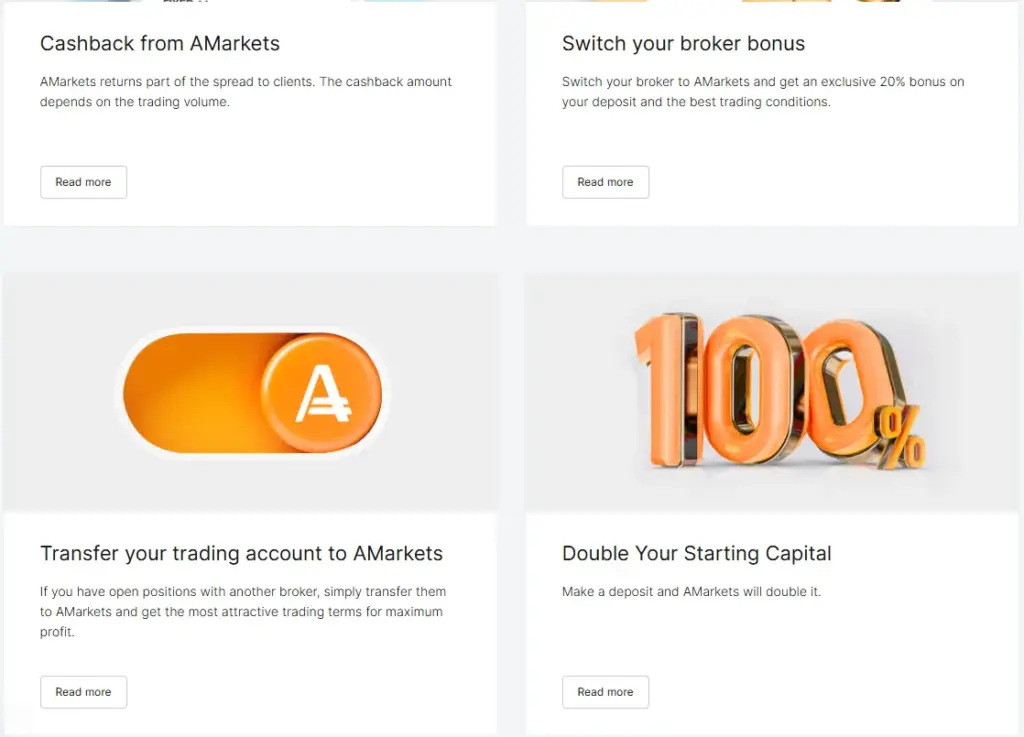
Bonus policy is the “Achilles’ heel” of many offshore brokers, and Amarkets is no exception. Bonuses here are not a gift but a marketing tool to hold your money hostage. The classic phrase “there’s no such thing as a free lunch” works 100% here.
How Bonuses Work in Practice
A trader is offered a deposit bonus (15% or 30% of the amount). It seems like luck – extra money in the account! But “the devil is in the details,” specifically in the bonus wagering requirements. In most cases, these are “hard” bonuses. This means the bonus funds and your own funds are “glued together.”
You cannot withdraw your profit or even your own deposit until you have traded a specific volume of lots. This volume can be tens of times greater than the bonus amount.
Specific “Pitfalls” of Wagering
One user described a classic situation: he took a bonus, earned $250 in profit, and tried to withdraw it. He received a refusal stating: you have not traded the required lot volume because you activated the bonus. In response to the complaint, the company confirmed that the conditions must be met for withdrawal. The trader who doesn’t read the fine print falls into a trap: his own money becomes hostage to the bonus.
An even more elaborate scheme, dubbed the “Amarkets Cashback Scam.”
A user describes a situation with cashback (rebate of part of the spread):
- Cashback is automatically credited to the client’s account.
- The client, having a zero balance (only cashback), makes a small trade with it.
- The trade closes at a loss, zeroing the account.
- The system automatically writes off the entire amount of previously credited cashback.
The rules state that cashback is forfeited when the account balance hits zero, but the client claims they were not warned that these funds couldn’t be used for trading. It turns out that bonus/cashback funds exist only on paper, and any attempt to use them leads to a lock.
Conclusion: Any Amarkets review that does not warn about the danger of bonuses is biased. It is strongly recommended to never activate bonuses unless you are prepared to deposit amounts significantly exceeding the bonus and trade with frantic activity to meet the lot requirements. Otherwise, your money will be trapped.
Amarkets Review. Client Reviews: Polarized Opinions and Red Flags
Analysis of reviews on independent platforms paints an extremely contradictory picture.
Negative Reviews and Systemic Problems
It is the negative reviews that provide food for thought and reveal patterns that cannot be ignored in any serious Amarkets review:
Amarkets Review. Withdrawal Problems (the most frequent and frightening category):
- Refusal after Bonus: The story described above, where withdrawal is blocked due to unmet bonus conditions.
- Endless Verification: Complaints that after a withdrawal request, the account undergoes a lengthy “security check.” In one report, a trader stated that after a profitable trade, the withdrawal was delayed for 10 days with excuses of “compliance checks,” after which the money was never received.
- Commission Deductions: Clients complain that commissions are deducted upon withdrawal, even though their absence is declared.
- Complete Disappearance of Funds: There are direct accusations that after a withdrawal request, the money simply doesn’t arrive, and support stops responding substantively.
Allegations of Unscrupulous Personnel:
The loudest accusation that periodically surfaces on forums is linked to the name Denis Kulagin. The FPA directly states that this former marketer of MFX Broker (a company caught creating a financial pyramid and disappearing with clients’ money) now works at Amarkets. For the community, this is a “red flag,” signaling a possible continuity of unethical business practices. One FPA user wrote directly: “When I saw Denis Kulagin’s name on FPA, I immediately withdrew my entire balance.”
Technical Manipulations:
Complaints that during important news releases, the platform “freezes” or anomalous slippage occurs, causing stop losses to trigger even though the price did not reach the specified level.
Analysis of Contradictions
Why are there so many positive reviews and yet so much negativity?
- Client Segmentation: Brokers often treat different categories of clients differently. “Scalpers” using robots and generating steady commission income may not experience problems. “Bonus hunters” trying to withdraw profits, and inactive clients, often do.
- Geolocation: Treatment of clients from different countries may vary.
- The Price of Loyalty: Reviews on platforms like Trustpilot can be moderated by the company itself, while on specialized forums, traders are more critical, independent, and not subject to moderation.
Amarkets Review. Conclusion: Is It Worth the Candle?
Summarizing this Amarkets review, the following conclusions can be drawn.
Amarkets is a typical representative of the “gray zone” of the Forex market.
The risks associated with working through this broker are extremely high and should not be underestimated.
Main Disadvantages of Working with Amarkets (Amarkets Review Summary):
Amarkets Review. Legal Vulnerability
Lack of an FCA, CySEC, or ASIC license. Registration in the offshore zones of St. Vincent and the Comoros means your money is protected by neither a government compensation scheme nor an independent regulator. In case of problems, you are left alone with the company.
Amarkets Review. Bonus Trap
The terms for wagering bonuses are designed to hold your own funds hostage. By not activating a bonus, you miss out on a “perk,” but by activating it, you risk losing the ability to withdraw.
Amarkets Review. Systemic Withdrawal Issues
Despite many positive reviews about fast payouts, the number of complaints about withdrawal blocks, especially after profitable trades or when using bonuses, is systemic. This indicates that the company may use “profit protection,” delaying or canceling payments to “inconvenient” clients.
Amarkets Review. Dubious Management Reputation
Links to individuals involved in scandals like MFX Broker undermine trust at an institutional level.
Amarkets Review. Aggressive Marketing
Luring clients through partners, promising “ultra-high” leverage and easy money, attracts unprepared traders who are highly likely to lose their deposits.
Amarkets Review. Advice for Potential Clients:
If you still decide to open an account with Amarkets, approach it with extreme caution:
- Never take bonuses. Trade only with your own funds to maintain control over withdrawals.
- Keep screenshots and correspondence. This may be useful in case of a dispute.
- Consider alternatives. If you have the opportunity, choose brokers regulated by the FCA or CySEC, even if their conditions (leverage, minimum deposit) seem less attractive. Your main priority should be the safety of your capital.
In the world of finance, there are no free lunches. Amarkets offers you a “tasty menu,” but the bill for it may turn out to be exorbitantly high. Remember, choosing a broker is not a choice between a spread of 0.2 and 0.8 pips. It is a choice between sleeping soundly, knowing your money is safe, or wondering if you’ll ever see it again after submitting a withdrawal request.
Check the ratings and reviews of brokers on the page. Also read the articles in the News section.
More information about forex brokers’ affiliate programs is available on the website.
Please sign in to your account to leave a review