
Grand Capital
Grand Capital Review: Offshore Registration, Bonus Traps, and Real Trader Reviews
In the world of online trading, finding a reliable broker often feels like walking through a minefield. Thousands of companies promise the moon, but behind the beautiful promises, there are often risks that beginners don’t even suspect. Today, our object of close scrutiny is the company Grand Capital. In this Grand Capital review, we will analyze in detail, as fully and honestly as possible, all aspects of this broker’s operations: from its legal status and offshore “regulation” to the conditions for wagering bonuses and what real clients write in their reviews.
If you are considering the possibility of cooperating with this company or are already its client, this article will help you understand what you are really dealing with. We’ll start with the most important thing — where the broker is registered and what that means for your money.
Grand Capital review. Legal Anatomy: Offshore Registration and Its Significance for the Client
The first thing a conscious trader should look at is regulation. It is a guarantee that your funds are at least somewhat protected and that the broker is obliged to comply with strict financial laws. Let’s go to the official broker’s website, to the “Regulation” section, to see the situation with our own eyes.
Grand Capital review. MISA License (Union of the Comoros): A Decoration or Protection?
According to information on the site grand.capital/about/regulation/, in 2024 Grand Capital received a license from the Mwali International Services Authority (MISA, Union of the Comoros). Sounds impressive? Now let’s translate this from marketing language into the language of facts.
Grand Capital review. What are MISA and the Comoros?
The Union of the Comoros is a small island nation off the eastern coast of Africa. It is a classic offshore zone. Obtaining a license for financial activities there is, to put it mildly, an uncomplicated and inexpensive process. The requirements for capital, reporting, and counterparty verification are minimal. For many brokers, having such a license is nothing more than a “piece of paper” to formally have a legal address and create an appearance of legitimacy.
Grand Capital review. What does operating under an MISA license mean for the client?
- Lack of Real Oversight: A regulator like MISA does not have the resources, desire, or authority to actually control the broker’s activities. If you have a million-dollar dispute with the company, filing a complaint in the Comoros is useless. They simply don’t have the mechanisms to resolve such disputes in the client’s favor.
- Segregation of Funds in Question: Reputable regulators (e.g., the FCA in the UK or CySEC in Cyprus) require that client funds be held in separate accounts from the company’s funds. In the Comoros jurisdiction, this control is practically non-existent. Technically, the broker could dispose of client money as if it were its own, which carries colossal risks, especially if the company faces financial difficulties.
- Minimum Entry Threshold: Such a license confirms only one thing: the company paid a fee and submitted a minimum package of documents. It says nothing about its reliability, transparency, or financial stability.
Thus, the proud statement about “commitment to global standards” against the backdrop of a license from the Comoros looks, to say the least, like an exaggeration. It’s a marketing ploy designed to lull a trader’s vigilance.
Grand Capital review. Membership in the Financial Commission (FinaCom): Insurance or Illusion?
On the same page of the Grand Capital website, it is stated that since 2016 the company has been a member of the Financial Commission (FinaCom). It also mentions the “highest reliability rating A” and a compensation fund of up to €20,000.
What is FinaCom?
It is an independent external arbitrator that resolves disputes between traders and member brokers. Not a government regulator. It is, in essence, a private initiative, an alternative for brokers who cannot or do not want to obtain a license from serious regulators.
What does FinaCom membership provide?
There is indeed a plus: if you have a conflict with the broker (e.g., refusal to withdraw funds) and cannot resolve it directly, you can file a complaint with FinaCom. The commission will conduct an investigation. If it rules in your favor, the broker will be recommended to pay compensation. The maximum compensation from the fund is €20,000.
What’s the catch?
- FinaCom is not a regulator. It cannot conduct unscheduled inspections, demand financial statements, revoke a license, or initiate criminal proceedings. Its main lever of pressure is expulsion from membership, which is not a serious threat for an unscrupulous broker.
- Reliability category A is an internal assessment. This category is assigned by FinaCom itself based on an analysis of data provided by the broker. But again, this is not an audit by a government body. It’s more of a marketing badge that a paying member (the broker) can place on their website.
- Compensation up to €20,000 is a ceiling, not a guarantee. Firstly, you can only get this compensation if the broker refuses to pay and FinaCom finds them wrong. The process can be long. Secondly, if the broker has all its money stolen or goes bankrupt, the FinaCom fund may simply be unable to pay compensation to all victims. €20,000 is the maximum per client, but the total fund size is limited. In case of a large-scale collapse, there won’t be enough money for everyone.
Grand Capital review. Summary of Legal Status
Grand Capital is a typical representative of the “gray zone.” It does not have licenses from respected top-tier regulators (FCA, CySEC, BaFin, etc.). Instead, it has an offshore license from the Comoros Islands and membership in a non-governmental dispute resolution commission. For the client, this means one thing: you are entrusting your money to a company that operates with a minimal level of legal responsibility. In case of serious problems, protecting your rights will be extremely difficult and expensive.
Grand Capital review. Promotions and Bonuses: Generosity That Will Cost You Dearly
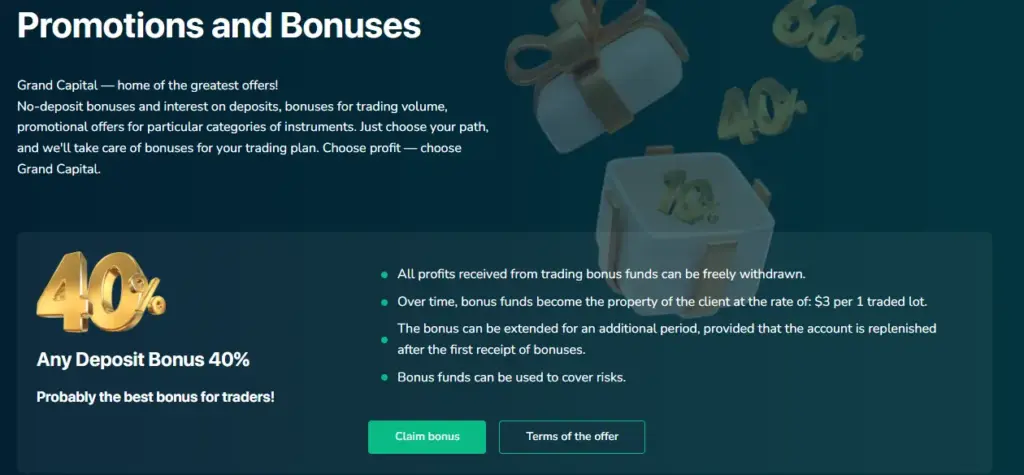
Brokers operating offshore often lure clients not so much with trading conditions, but with huge bonuses. Grand Capital is no exception. On the website, you can find offers for deposit bonuses of up to 100% or more. It sounds tempting: you deposit $100, and you already have $200 in your account. But the devil, as always, is in the details.
Bonus Mechanics: Credit Leverage and Hidden Conditions
You need to clearly understand the nature of most such bonuses. In 90% of cases, these are so-called credit bonuses. They are not credited to your account as real money. They are a virtual amount that allows you to trade with a larger volume, but it hangs over you like the sword of Damocles.
- Not Your Money: The bonus is the company’s money, lent to you for trading. You cannot withdraw it immediately.
- Wagering (Trading Volume Requirement): To turn the bonus into real funds that can be withdrawn, you need to “trade it off.” Usually, you are required to execute trades for a certain volume. For Grand Capital, these conditions are often written in the fine print of the User Agreement. For example, to wager a 100% bonus, you might need to achieve a turnover several tens of times greater than the sum (bonus + deposit).
Grand Capital review. Wagering Conditions: Why 99% of Traders Don’t Fulfill Them
This is where the main trap lies. The wagering conditions are deliberately designed so that the client either doesn’t fulfill them or finds it extremely difficult to do so.
Huge Turnover Requirements
Suppose you deposited $100 and received a $100 bonus. To wager it, you might need to execute trades totaling 40 lots (that’s about $4,000,000 turnover with a standard lot). For a beginner with a small deposit, this is a cosmic figure.
Time Limit
Often, there is a limited time to wager the bonus — for example, 30 days. This pushes the trader towards risky trading, increasing volumes to meet the deadline. Risky trades lead to the deposit being blown.
Prohibition on Strategies
Brokers reserve the right not to count trades they deem “arbitrage” or “low-risk” towards the turnover. If you try to simply “churn” volume back and forth seeking break-even, this may be annulled.
Loss Deduction Priority
The most insidious condition. In most cases, when you trade with bonus funds, losses are first written off against your real money, and only then does the bonus get eaten into. That is, you risk losing your hard-earned money trying to wager the company’s virtual funds.
Result: Grand Capital’s bonuses are a marketing tool to make you deposit more and trade more aggressively. The statistics are relentless: the vast majority of traders who take bonuses lose their deposits without ever fulfilling the wagering requirements, or they withdraw pennies while the bonus is canceled. Bonuses benefit the broker, not you.
Grand Capital review. Client Reviews Online: A First-Hand Picture
When researching any broker, reviews from real people are the most valuable source of information. Grand Capital has been on the market since 2006, so an extensive base of opinions has accumulated on forums (like Forex Factory, MMGP, local forums) and review sites. We analyzed them, filtering out obviously fake ones, and identified the key problems clients face.
Grand Capital review. Positive Reviews: What Do They Praise?
It wouldn’t be fair to say that only bad things are written about the broker. Positive reviews usually touch on the following points:
- Long-standing history. The company has indeed been around for a long time, which creates an illusion of stability.
- Convenient platform. Many praise the terminals, including the web version and mobile apps, for their convenience and functionality.
- Variety of assets. The availability of not only currency pairs but also stocks, commodities, and cryptocurrencies.
- Fast deposit of funds. Depositing money is usually indeed easy and quick.
However, note: they mostly praise the interface and deposit speed, but rarely — problem-free withdrawals.
Grand Capital review. Negative Reviews: Systemic Problems
This is the most important part of our Grand Capital review. The negativity from clients is surprisingly uniform, which points to systemic problems in the company’s operations.
Problems With Fund Withdrawals (the most common complaint)
This is the “Achilles’ heel” of many offshore brokers. Typical situations:
- Sudden Verification: A client trades successfully, withdraws small amounts, but when requesting to withdraw a large sum (or the entire deposit), they are asked to undergo “additional verification,” send a photo of their passport, utility bills, a photo holding their passport, etc. The process can drag on for weeks, and then a refusal follows for a contrived reason.
- Cancellation of Requests: Withdrawal requests sit in “processing” status for days and then are canceled without explanation or with the wording “technical glitch.”
- Fees and Limits: Withdrawals are subject to hidden fees, or ridiculously low daily/weekly withdrawal limits are set.
Requotes and Price Manipulation
Many traders complain about sharp price spikes (spikes) during important news events, resulting in stop-losses being triggered. In broker circles, this is called “hunting for stops.” Of course, proving intent is difficult, but the suspicious number of coincidences leads traders to suspect the broker of unfair play.
Technical Glitches on the Platform
Reviews contain complaints about the terminal freezing during moments of high volatility. As a result, the trader cannot close a losing position, and losses multiply. In such cases, the broker throws up their hands, citing problems with the client’s internet or provider.
Aggressive Support and Pressure
A typical situation occurs when a client decides to withdraw all money and stop trading. After that, personal managers start calling them with offers of “exclusive bonuses,” “help from an experienced trader,” and persuasion to stay. If the client insists on withdrawing, the tone may change to rude or ignoring.
Difficulties With Bonuses Upon Withdrawal
Those who took bonuses, when trying to withdraw, face the requirement to wager them or the cancellation of the bonus, which automatically reduces the withdrawal amount (since part of the money was bonus funds). Many complain that they got “bonused in” and are not allowed to withdraw even their own funds without fulfilling onerous conditions.
Grand Capital review. Disadvantages of Working with Grand Capital: The Truthful Verdict
Summing up all of the above, we can compile an objective list of disadvantages for a trader deciding to cooperate with this broker.
Grand Capital review. Main Disadvantages:
Offshore Registration and Lack of a Serious License
This is a fundamental drawback that outweighs many pros. Your money is not protected by the laws of any developed country. The Comoros jurisdiction is a red flag for any experienced investor.
FinaCom “Regulation” as a Smokescreen
Membership in a non-governmental commission does not provide the protection that a real regulator offers. The €20,000 compensation fund is more of a marketing gimmick than real insurance.
Bonus Policy Leading to Losses
The bonus wagering conditions are designed so that the client is highly likely to lose their deposit or be unable to withdraw profits along with the bonus. It’s a money-attraction tool, not a concern for the client.
Systematic Problems With Fund Withdrawals
Thousands of reviews testify to delays, refusals, and additional checks precisely at the moment the trader wants to take their money.
Conflict of Interest.
As a market maker, Grand Capital often acts as a counterparty to its clients. This means it is in the company’s interest for the client to lose money. Hence the suspicions of price manipulation and “slippage” at inconvenient moments for the trader.
Opacity
The company’s real financial statements are not published. We do not know where client money is actually stored or if it is used in the company’s commercial activities.
Grand Capital review. Conclusion
Grand Capital is a classic example of a broker operating on the periphery of the financial world. Using offshore registration, it attracts clients with loud promises, bonuses, and a long history.
For some, it might seem like a working tool, especially if you trade small and manage to withdraw profits before problems arise. But from the perspective of reliability and capital protection, this broker represents a high risk. The legal status leaves the client with virtually no chance in the event of a serious conflict.
Before depositing real money, ask yourself the main question: are you willing to entrust your savings to a company registered on an island in the Indian Ocean and regulated by a local authority that no one has ever heard of? The reviews from thousands of traders who have already faced withdrawal problems provide an unequivocal answer to this question.
There are many brokers in the world with real FCA or CySEC licenses who, despite having their own drawbacks, provide at least some guarantee of security. The choice is always yours, but in the case of Grand Capital, this choice is more like playing roulette, where your money is the bet, and the ball has long been rigged in favor of the casino.
Check the ratings and reviews of brokers on the page. Also read the articles in the News section.
More information about forex brokers’ affiliate programs is available on the website.
Please sign in to your account to leave a review